
Does video really increase bookings?
Should we do this in-house or outsource it?
This article answers both, from real account experience and real data.
All figures in this article are as of June 2026.
What this article covers
- 1. Why POV video performs for hotels
- 2. How views turn into bookings
- 3. A filming and posting method you can reproduce yourself
First, what is POV video? Short-form video shot from the first person
POV stands for point of view: video that shows exactly what the person filming sees.
Holding the camera at eye level and filming the work in your hands or the view as you walk gives the viewer the sense of being there themselves.
For a hotel, that means subjects like cleaning a guest room or preparing breakfast.
1. Why POV video performs for hotels
Show the process of things coming together, not the finished result
Not every POV video performs. What you show decides it.
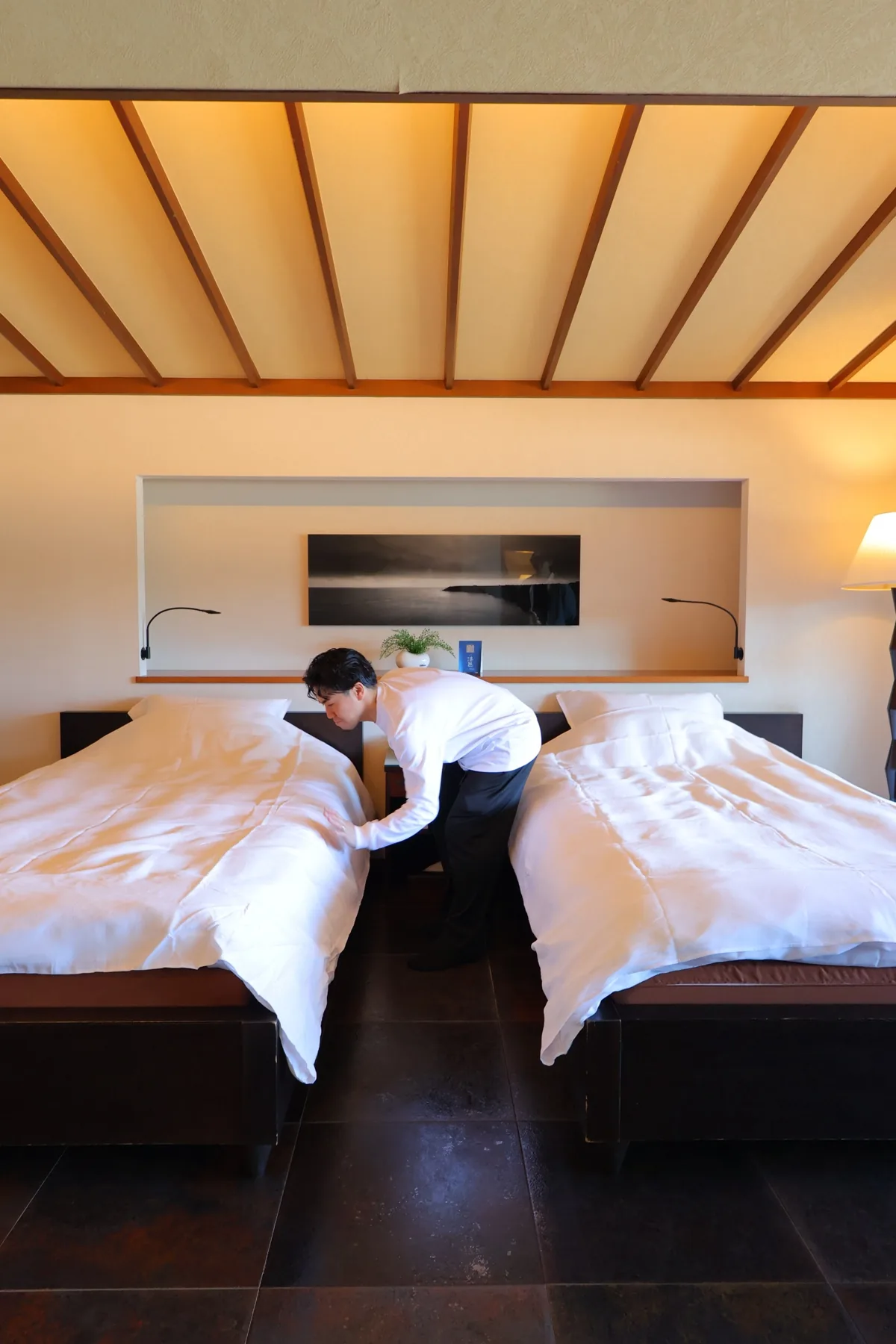
For a hotel, viewers are drawn less to the finished, immaculate room than to the process: sheets being straightened, bathrooms polished, the room gradually coming together.
There is value, too, in the scenes guests never normally see — what happens behind the cleaning, for instance.
The trap: beautiful footage that goes nowhere
It is easy for a hotel to assume that if the footage is beautiful, it will perform.
Beautiful footage is good for branding, but over-produce it and it reads as advertising — which on social media means people scroll past.
What actually performed was real work, shown in short cuts at pace.
Precisely because the first-person view is unpolished, people watch without putting their guard up.
Comments increase when you show the people who work there
The other thing that drove growth was getting people interested in the people, not the property.
At Shimoda View Hotel, the breakfast buffet video featuring a member of the international staff took off.
Attention gathered around how they worked with guests and what they were like, and comments came in along the lines of "nice to see people like this working here".
Interest in the people who work there, not only the facilities, is what makes someone warm to a property.
Footage like this breakfast buffet carries almost no spoken explanation, which means it can be reused on a multilingual account by swapping the subtitles and voiceover alone. How to approach visitors from overseas is covered on our Inbound marketing for hotels and ryokan covers how to choose the countries you target and how to launch multilingual accounts.
2. Do views actually turn into bookings?
In short: yes. At Shimoda View Hotel, revenue rose through TikTok Go.
Six videos posted in one month drew roughly 7 million views across TikTok, Instagram and YouTube combined.
When video reaches enough people, a sequence follows:
watch the video → learn the property exists → become interested → compare it with others → book
Of course, the path to booking matters too — a booking link in the profile, for instance.
But the entrance to all of it is getting seen by enough people in the first place.
Why bringing in professionals moves the numbers
While Shimoda View Hotel ran the account itself, views stubbornly refused to grow.
What changed that was testing and improving video by video.
Why did this one perform?
Why didn't that one?
We checked the numbers on each video and fed what we found into the next one.
That accumulation grew both views and followers, and the one-million-view target was reached in about three months.
We don't just produce the videos. We analyze why they performed and design the path that turns that into revenue. To hand over everything from filming to posting and analysis, see Social media management for hotels and ryokan; to design the whole path, including traffic to booking sites and repeat visits through LINE, see Full-Funnel Marketing.
3. Short-form video tips a hotel can use tomorrow
Here are the points from the Shimoda View Hotel work that any hotel can put into practice.
Tip 1: win their interest in the first five seconds
In short-form video, how long people keep watching is what counts.
The first five seconds matter most. Fail to interest them there and they are gone immediately.
So rather than beauty or volume of information, think about a structure that makes people want to see what comes next.
Tip 2: cut down to one or two seconds
One change that clearly worked, as we kept testing, was shortening the cuts.
Early on each cut ran three to five seconds; testing brought that down to one or two.
Switching scenes at pace keeps the viewer from getting bored.
Tip 3: film the real workplace, unstaged
You need no special equipment and no elaborate staging.
Showing the workplace as it ordinarily is matters more.
As AI-generated content proliferates, real people doing real work is exactly where the value lies.
What should a hotel actually film?
Build your subject around either a process coming together or the people doing the work.
For example:
- Guest room cleaning, before and after
- Cleaning the communal bath and bathrooms
- Prep and plating for breakfast or dinner
- Getting the property ready before check-in
At Shimoda View Hotel too, it was the scenes guests never normally see — room cleaning, the breakfast buffet — that performed.
Four steps to get started
1. Pick one process to show
Cleaning, food prep — narrow it to a single theme first.
2. Decide who films
Choose someone who can work normally on camera rather than someone who can act. Picking on personality works well.
3. Film in first person
Hold the camera at eye level so your hands are in frame. No special equipment needed.
4. Cut it short and test
Aim for one to two seconds per cut, and put something that grabs attention in the first five seconds.
After posting, check how many seconds in people dropped off and what share watched to the end, then apply that to the next video.
You can also outsource only the filming and editing. For how a single shoot yields enough footage for a month, see POV video for hotels and ryokan page.
In summary: what matters in social media marketing for hotels
Four points emerged from the Shimoda View Hotel work.
- Show the process of things coming together, not the finished property
- Think about the first five seconds and the pace, not how beautiful the footage is
- Show the people who work there, and turn that into interest and warmth toward the property
- Analyse the numbers after posting and apply them to the next video
Social media marketing for a hotel is not about hoping something happens to go viral.
Build a repeatable way of filming, then post and test repeatedly. That is what produces results that last.
It starts with finding one scene at your property that guests never normally get to see.
For the advantages of POV video itself — attention time, production speed, cost — see“What makes POV video work? Three reasons it changes social media marketing”. On filming equipment, see theInsta360 POV project as well.
Talk to us about social media management and POV video for your property
If your in-house account has stalled, or you want video to turn into bookings, just get in touch. We will bring the method we built on the ground in Shimoda exactly as it is.
Book a free consultation →